

Tradition Meets Technology: Buffalo, Data, and Unlocking Community Resilience
Returning Buffalo to their historical range offers many opportunities for the Wind River Tribes

.webp)




The western part of Wyoming is breathtaking; rolling plains merge into the distant foothills of the Snowy Mountains. Beautiful, but harsh. Hours from familiar roads and through sparsely inhabited towns, I get the feeling that life out here has never been easy.
We are headed to Riverton, a small town in west-central Wyoming, crouched at the confluence of the Big and Little Wind Rivers. The town is built on land ceded from, and surrounded by, the Wind River Indian Reservation—where the Eastern Shoshone and Northern Arapaho Tribal communities now live.
My co‑worker, Steven LeBlanc, has driven this route many times, but it’s a first for me. We both work for the NSF ASCEND Engine, part of the National Science Foundation’s (NSF) Regional Innovation Engines program. The Engine works to turn innovation into impact. There are nine NSF Engines across the United States, and in our case, we are specifically focusing on sensing and computation technologies that will spur economic growth and enhance community resilience.
Jason Baldes, the Executive Director of the Wind River Tribal Buffalo Initiative (WRTBI), has invited us out to attend a buffalo release (Eastern Shoshone herd) and a buffalo harvest (Northern Arapaho herd). Founded in 2022, the WRTBI serves as the organizing entity for both tribes concerning land acquisition, buffalo management, and education. The Initiative's goal is to restore buffalo to the reservation and, in doing so, revitalize their communities, educate their youth, and make their land and tribes more resilient to economic and environmental hazards.
I am looking forward to it. WRTBI is deeply invested in community resilience and is eager to explore using environmental science and novel technology to better understand and leverage the ecological advantages of the Tribes’ growing Buffalo herds.
The fact that there are any buffalo at all on the reservation is a miracle. From herds numbering in the tens-of-thousands, the last free-roaming buffalo in the Wind River Basin was recorded in 1885. With their disappearance, both the land and the indigenous people suffered.
Buffalo play a crucial role in maintaining the balance of the ecosystems they inhabit. The reintroduction of buffalo has been associated with increased native plant species and the restoration of grassland biodiversity. This, in turn, promotes drought resistance—a major concern in many parts of Wyoming. The Eastern Shoshone and Northern Arapaho cultural, physical, and spiritual well‑being are also closely tied to buffalo.
Returning buffalo to their historical range in Wind River offers many opportunities: the return of traditional food sources, improved ecological resilience, and a chance to marry traditional knowledge with new technologies. WRTBI has a talent for blending tradition with cutting‑edge innovation, placing them at the center of fostering community resilience in the form of healthier landscapes, cleaner water, and new buffalo‑centered economic opportunities for those living on or near the Wind River Reservation.
Welcome to Wind River
Early the next morning, Steven and I meet Xavier Michael‑Young at a gas station on the edge of town. Michael‑Young is the Administrative and Finance Coordinator for WRTBI and a graduate student at the University of Wyoming studying ecotourism. He has offered to lead us to the difficult‑to‑find release site. Tall and friendly with an easy smile, he offers a quick greeting before we head to the Reservation—an area of prairie and mountains covering approximately 3,500 square miles.
Buffalo had been absent from this landscape for over a century—until 2016, when the Eastern Shoshone Tribe partnered with the National Wildlife Federation and the U.S. Fish and Wildlife Service to reintroduce the first ten animals back onto tribal lands. Since this original effort, additional partnerships have rematriated genetically pure buffalo to Wind River, and together the Eastern Shoshone and Northern Arapaho herds now total about 200 animals.
According to the WRTBI website, the term rematriation is preferred over reintroduction because:
“Land rematriation is restoring keystone species and land ownership to Tribes. Much of what was brought here was patriarchal. The culture of Buffalo has been matriarchal. Rematriation is giving back to Mother Earth, bringing back a holistic connection, and empowering the role of women.”
For Wind River Tribes, rematriation is an inflection point—a reconnection to their past with the potential to alter their future. “Buffalo was our food, our clothing, our shelter—but also central to our cultural and spiritual belief systems,” says Baldes. “It’s been missing for a long period of time, and so to restore that animal to our communities means we can begin to heal.”
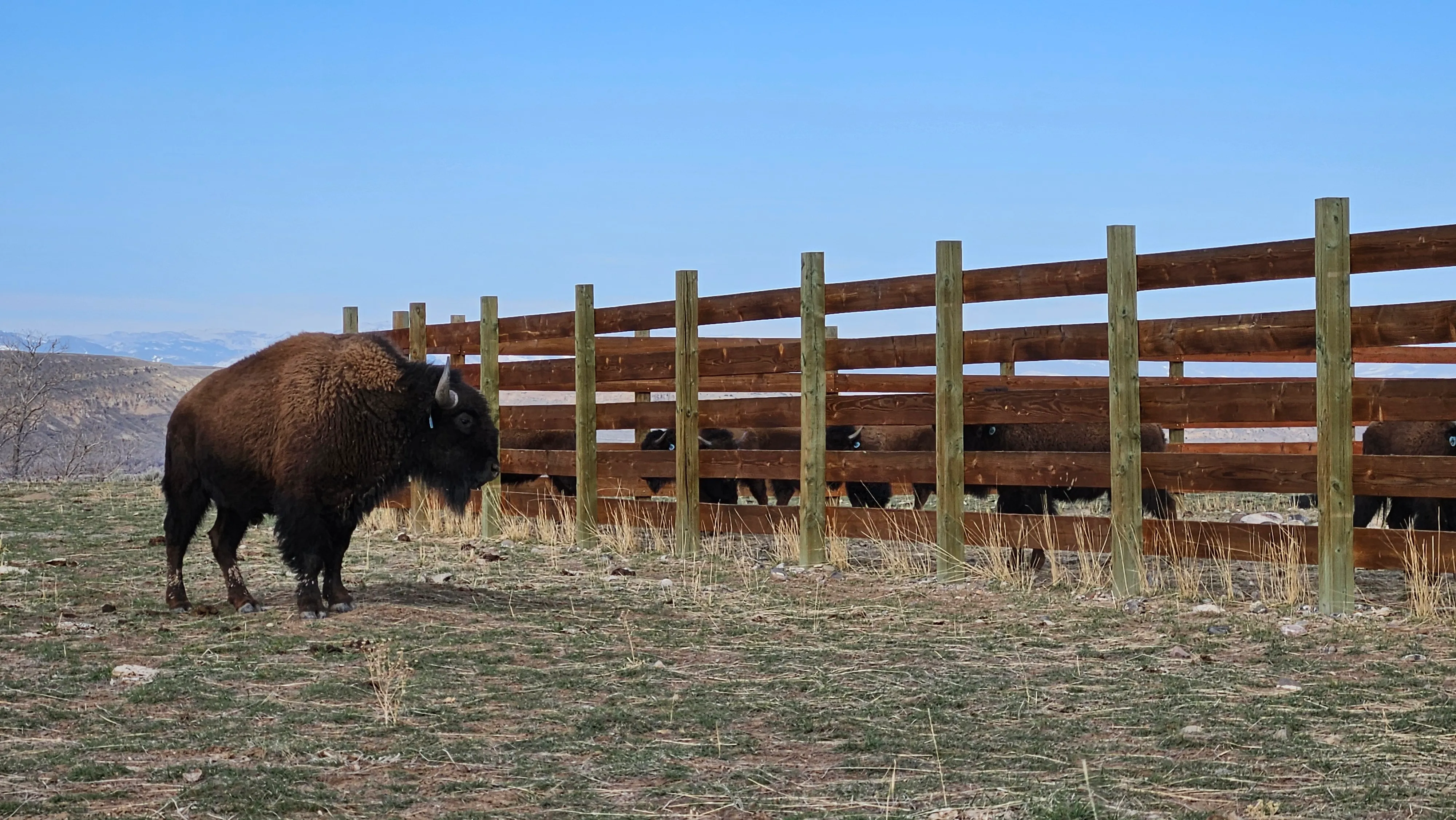
Michael‑Young, Steven, and I are the first to arrive at the corral, a sturdy structure holding eleven buffalo from Colorado’s Soap Stone Prairie. The posts and thick wooden slats seem excessive, but Michael‑Young notes with a nod toward the animals, “If they really wanted to get out, they could.” Luckily, the buffalo seem content where they are, puffing breath into the frigid air.
More people arrive, undeterred by the cold or remote location: elders, parents with children bundled in brightly colored blankets, curious onlookers. And the people aren’t the only curious ones. A few resident buffalo make an appearance to sniff questioningly at the newcomers.
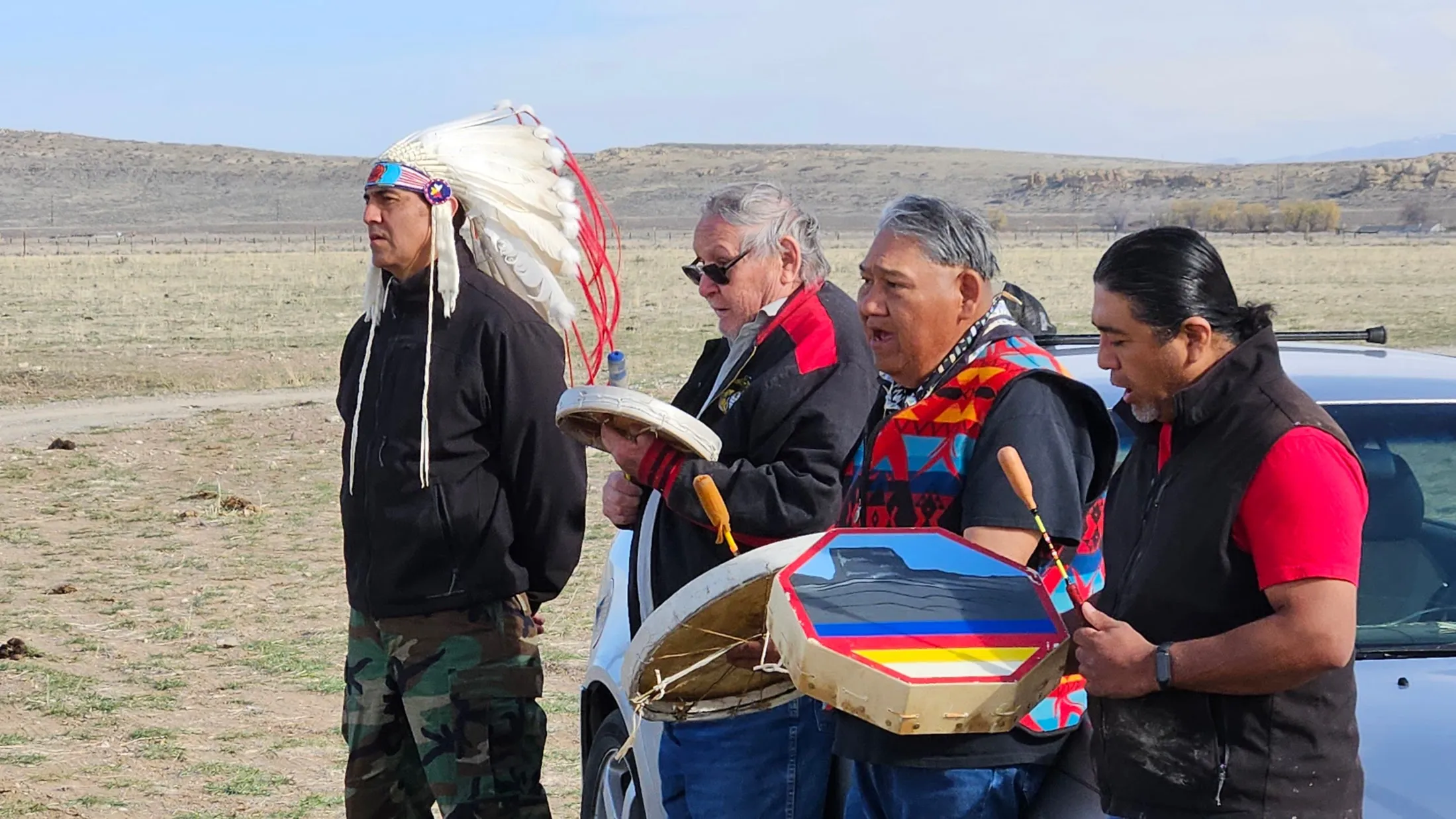
Eastern Shoshone Elders welcome the new additions with a song and prayer before the gate is opened. Within seconds, all the buffalo, new and old, have disappeared over the ridge and out of sight.
Returning Knowledge to the Next Generation
We then head over to the Northern Arapaho herd for the buffalo harvest. Harvests are community events and a valuable opportunity to pass on traditional knowledge to tribal youth.
We catch up with Albert Mason Jr., WRTBI’s Science Director, who tells us what to expect. Buffalo vary greatly from cattle, he explains. They are curious, unafraid of humans, and when they lose a herd member, they mourn.
I don’t fully grasp what he means until I see it myself. After a young bull is shot and slumps to the ground, the herd does not flee. Instead, the animals encircle the downed body. They nudge, lowing softly. When nudging fails to bring the animal back to life they hold a quiet vigil. Everyone is quiet. Mason Jr.’s eyes are dark as he watches: “I still cry every time,” he says.
.webp)
We give the herd space. When they disperse, the elders approach and place their hands on the buffalo’s soft brown flank and head, whispering prayers and thanks. Youth follow until everyone has paid their respects. The scene feels like a wake and a baptism; a respectful end and a promising beginning.
Patti Baldes, a local artist and Executive Director of the Wind River Native Advocacy Center (and Jason’s wife), begins the harvest by teaching a group of adolescents how to remove the hide. Another adult guides a young man in removing the head. Conversations flow over and around each other: This is how you remove the tongue; these are the uses for the tail and the horns; be sure to avoid cutting into the stomach. I end up bracing a leg as two young men work on removing the hide. Steven, an experienced hunter, joins the group working to remove the internal organs.
Several buffalo creep closer, watching us curiously. I ask Michael-Young why they don’t flee. “Why would they run away?” He asks, “They are our relatives.”
Hours pass. The sun is low by the time the final quarter of meat is winched into the harvest trailer. The meat will be processed and distributed to a local food bank serving reservation residents.
It is cold, and everyone is tired. The Wyoming wind, which has been uncharacteristically quiet, begins to rise. Steven and I make our way back to the truck for the long drive home. I think about the harvest the entire trip, trying to categorize the experience in my head. I have never witnessed anything like it—death and blood, community and knowledge braided together. Eventually, I give up trying to sort it all out and simply accept what remains: gratitude for being welcomed into this moment, and for what I have learned.
From First Meeting to Now
To date, the NSF ASCEND Engine has helped channel funding to support WRTBI in several ways. We have collaboratively identified unique research opportunities and overlap in resilience strategies, such as building a tribal knowledge‑centered STEM curriculum for youth and supporting WRTBI’s interest in soil health by connecting them with our soil health program. Soil experts, such as Engine Grantee Professor Francesca Cortrufo at the Soil Innovation Laboratory at Colorado State University, can help WRTBI define research methodology and support the implementation and utilization of advanced environmental sensing technologies. We look forward to finding additional ways to connect WRTBI with our regional ecosystem of innovators and finding pathways for WRTBI to create a more resilient future.
These are just a few steps among many. In the last year, both the Eastern Shoshone and Northern Arapaho Tribes designated buffalo as wildlife under Tribal law and acquired over 700 acres of habitat. The story unfolding here is larger than any single buffalo release, harvest, or celebration. The return of buffalo is not just ecological restoration — it is cultural reclamation, and a living blueprint for how tradition and technological innovation can move forward together.